Fukushima: Radiation Exposure
Radioactivity
Radioactive releases are measured by the amount of radioactivity in the material (sometimes referred to simply as ‘activity’), and quoted in Becquerels. Whether this is in the air or settled on the ground, it may expose people to ionizing radiation, and the effect of this is measured in Sieverts, or more typically milliSieverts (mSv). Exposure to ionizing radiation can also be by direct radiation from the plants and fuels themselves, though not released to the environment. This is only a hazard for those on the plant site, and the level diminishes with distance from the radioactive source. It is the chief hazard for the plant workers, who wear film badges so that the dose can be monitored. A short-term dose of 1000 mSv (1 Sv) is about the threshold of acute radiation syndrome (sickness). An instant dose of 100-250 mSv can slightly increase the risk of later developing cancer, but if this dose is spread over time there is less risk of any effect. On 17 March, the Japanese regulator (the Nuclear and Industrial Safety Agency, NISA) set 250 mSv as the maximum allowable dose for Fukushima recovery workers, under health physics controls. At the end of October this was reduced to 100 mSv for new workers. The International Commission on Radiological Protection (ICRP) allows up to 500 mSv for workers in emergency rescue operations.
Radioactivity in the cooling water flowing through the core is mainly due to the presence of nitrogen-16, which is formed when oxygen in the water captures a neutron emitted by radioactive material. N-16 has a half-life of only 7 seconds but produces high-energy gamma radiation during decay. (It is the reason that access to a BWR turbine hall is restricted during actual operation.) There is also often some leakage from fuel elements of fission products, including noble gases and iodine-131.
Regarding releases to air and water leakage from Fukushima, the main radionuclide from among the many kinds of fission products in the fuel was iodine-131, which is volatile, meaning it readily becomes a gas. Iodine-131 decays to inert and stable xenon-131. Iodine is readily taken up by the body and accumulates in the thyroid gland. Three months after the accident (after fission ceased) I-131 had virtually disappeared as a problem.
The other main radionuclide is caesium-137, which has a 30-year half-life. It is easily carried in a plume and when it lands it may contaminate land for some time. It is a strong gamma-emitter in its decay. Cs-134 is also produced and dispersed, and it has a 2-year half-life. Caesium is soluble and can be taken into the body, but does not concentrate in any particular organs, and has a biological half-life of about 70 days. In assessing the significance of atmospheric releases, the Cs-137 figure is multiplied by 40 and added to the I-131 number to give an 'iodine-131 equivalent' figure.
Radioactive releases
Supplement to information in main page
After the hydrogen explosion in unit 1 on 12 March, some radioactive caesium and iodine were detected in the vicinity of the plant, having been released via the venting. Further I-131 and Cs-137 and Cs-134 were apparently released during the following few days, particularly following the hydrogen explosion at unit 3 on 14 March and at unit 4 on 15 March. Considerable amounts of xenon-133 and iodine-131 were vented, but most of the caesium-137 (14 out of 15 PBq total) along with most of the Cs-134 apparently came from unit 2 on or after 15 March – the only one of the four units which did not suffer a hydrogen explosion demolishing its superstructure. Also, ten times more iodine is attributed to unit 2 than unit 1, while unit 3 produced half as much as unit 1. However, there remains some uncertainty about the exact sources and timings of the radioactive releases.
On 16 March, Japan’s Nuclear Safety Commission recommended local authorities to instruct evacuees under 40 years of age leaving the 20 km zone to ingest stable iodine as a precaution against ingestion (e.g. via milk) of radioactive iodine-131. The pills and syrup (for children) had been pre-positioned at evacuation centres. The order recommended taking a single dose, with an amount dependent on age. However, it is not clear whether this was implemented. On 11 April the government suggested that those outside the 20km zone who were likely to accumulate 20 mSv total dose should move out within a month. Data at the end of May (with most I-131 gone by decay) showed that about half of the 20 km evacuation zone and a similar area to the northwest, about 1000 km2 in total, would give an annual dose of 20 mSv to March 2012.
France's Institute for Radiological Protection & Nuclear Safety (IRSN) estimated that maximum external doses to people living around the plant were unlikely to exceed 30 mSv/yr in the first year. This was based on airborne measurements between 30 March and 4 April, and appears to be confirmed by the above figures. It compares with natural background levels mostly 2-3 mSv/yr, but ranging up to 50 mSv/yr in some parts of the world.
The main concentration of radioactive pollution stretches northwest from the plant, and levels of Cs-137 reached over 3 MBq/m2 in soil here, out to 35km away. In mid-May about 15,000 residents in a contaminated area 20-40 km northwest of the plant were evacuated.
The IAEA reported on 19 March that airborne radiation levels had spiked three times since the earthquake, notably early on 15 March (400 mSv/hr near unit 3), but had stabilized since 16 March at levels significantly higher than the normal levels, but within the range that allowed workers to continue onsite recovery measures.
NISA estimated that about 130 PBq of iodine-131 was released from the reactors, mostly around 15 March and the two days following – 0.16% of the total inventory. In 32 days this released iodine would have diminished to one-sixteenth of original activity – 8 PBq. NISA's report to the IAEA said that this 130 PBq of I-131 together with 6 PBq of caesium-137* released gave an 'iodine-131 equivalent' figure of 370 PBq, which resulted in the re-rating of the accident to INES level 7. NISA in June increased this estimate to 770 PBq (I-131 eq), being 160 PBq of I-131 and 15 PBq of Cs-137. Japan's Nuclear Safety Commission (NSC, a policy body) estimated that 12 PBq of Cs-137 had been released, giving an iodine-131 equivalent figure of 630 PBq to 5 April, but in August lowered this estimate to 570 PBq.
The 770 PBq figure is about 15% of the Chernobyl release of 5200 PBq iodine-131 equivalent. The NSC said that most radioactive material was released from the unit 2 suppression chamber during two days from its apparent rupture early on 15 March. It said that about 154 TBq/day was being released on 5 April, but that this had dropped to about 24 TBq/d over three weeks to 26 April and to about 24 GBq/d in mid-July. In mid-August 2011 the estimate from all three reactors together was about 5 GBq/d.
* The Cs-137 figure is multiplied by 40 in arriving at an 'iodine-131 equivalent' figure, due to its much longer half-life. Cs-134 is multiplied by 4.
Tepco estimates published in May 2012 showed a total of about 1020 PBq released to the atmosphere over 12-31 March 2011 (after which very little was released). Apart from noble gases this comprised 500 PBq iodine-131, 10 PBq Cs-137 and 10 PBq Cs-134. In iodine-131 equivalent terms this comes to 500 + 400 + 40 = 940 PBq iodine-131 eq released to the atmosphere. In addition, 500 PBq noble gases was estimated, mainly xenon-133. This is normally disregarded since it is not biologically active and has only a 5-day half-life. Of the total releases, about 20% came from unit 1, 40% from unit 2 (peak on 15 March), and 40% from unit 3 (peak on 16 March). Releases to the ocean over 26 March to 30 September were about 11 PBq iodine-131, 3.5 PBq Cs-134, 3.6 PBq Cs-137, total 18.1 PBq (or 169 PBq I-131 eq) apart from atmospheric fallout. Relatively little radioactive material was released by the active venting of pressure inside the reactor vessels (routing steam through water and releasing it through the filtered exhaust stacks) or by the hydrogen explosions.
In 2014 Fukushima University’s Institute of Environmental Radioactivity said that the total amount of Cs-137 released was 20.5 PBq, 17 PBq to the air, and of the total, 12 to 15 PBq ended up in the Pacific Ocean. The 17 PBq to air, coupled with the I-131, would give 810 PBq (I-131 eq).
Radiation effects
Supplement to information in main page
No harmful health effects were found in 195,345 residents living in the vicinity of the plant who were screened by the end of May 2011. All the 1,080 children tested for thyroid gland exposure showed results within safe limits, according to the report submitted to IAEA in June. By December, government health checks of some 1700 residents who were evacuated from three municipalities showed that two-thirds received an external radiation dose within the normal international limit of 1 mSv/yr, 98% were below 5 mSv/yr, and ten people were exposed to more than 10 mSv. Therefore, there was no major public exposure, let alone deaths, from radiation.
Some aspects of public policy response to the accident did, however, have measurable health impacts, which are recorded as ‘disaster-related deaths’. Among these were a number of old people uprooted from homes and hospital because of forced evacuation and other accident response measures. The psychological trauma of evacuation was a bigger health risk for most than any likely exposure from early return to homes.* Over 2300 disaster-related deaths have been identified by the Japanese authorities, some 90% were deaths of people above 66 years of age and 70% of which occurred within the first three months of the evacuations.
* e.g. Hirooki Yabe et al., Fukushima Journal of Medical Science, 60, 1, 57-67 (2014)
In July 2012 a Hirosaki University study reported on I-131 activity in the thyroid of 46 out of the 62 residents and evacuees subject to detailed investigation in April 2011. The median thyroid equivalent dose was estimated to be 4.2 mSv and 3.5 mSv for children and adults respectively, much smaller than the mean thyroid dose in the Chernobyl accident (490 mSv in evacuees). Maximum thyroid equivalent doses for children and adults were 23 mSv and 33 mSv, respectively. This is consistent with health authorities' screening tests on children under 15 in March 2011. Working from these data to estimated maximum doses in the worst-exposed areas in the first week after the accident it was estimated that some children could have received more than 50 mSv dose, still only about one tenth of Chernobyl evacuees.*
* Shinji Tokonami et al., Thyroid doses for evacuees from the Fukushima nuclear accident, Scientific Reports, 2:507 (2012)
The residents of Minamisoma town, on the coast 23 km north of Fukushima Daiichi, were found to have very low levels of radiation contamination. In a study of internal radiation dose, measurements were taken of the full-body contamination from caesium exposure of 9498 residents who had returned to the town and stayed there between September 2011 and March 2012. The study found that two-thirds of the residents had no detectable levels of caesium. Of the rest, only one appeared to have received an equivalent dose more than 1 mSv, and that was 1.07 mSv. The current ambient dose rate in the town is about 3 mSv/yr from external sources, well within the government's 20 mSv/yr limit for returnees. Some 1500 of the town's 70,000 residents lost their lives in the tsunami. The internal dose results were published in the Journal of the American Medical Association.
In October 2012 the new Nuclear Regulatory Authority (NRA) released new emergency preparedness guidelines. Its new emergency planning zones, in line with International Atomic Energy Agency standards, call for 'precautionary action zones' 5 kilometres around nuclear energy facilities and 'urgent protective action planning zones' 30 km around the plants. NRA then drew up specific evacuation criteria, which local municipalities will use to formulate emergency response plans.
The UNSCEAR 2020/2021 Fukushima Report (published 2022) confirmed and strengthened the findings of its earlier 2013 report: no adverse health effects among Fukushima residents have been documented that are directly attributable to radiation exposure. The report also concluded that future radiation-associated health effects are unlikely to be detectable, and that the large increase in detected thyroid cancers is attributable to ultrasensitive screening rather than radiation exposure. Revised dose estimates were lower than those in the 2013 report, with ingestion doses reduced by up to 90% in lower-dose areas. The Fukushima Health Management Survey’s thyroid screening programme, now in its fifth round covering approximately 380,000 people who were 18 or younger at the time of the accident, has found no association between thyroid cancer detection and radiation exposure dose.
Japan's health ministry set up a special office to monitor the health of workers at the plant. The new office compiles data on radiation exposure for workers for long-term monitoring purposes, and inspects daily work schedules in advance. Tepco keeps records of radiation exposure for all workers at the site. In the period 2011-2015 six workers exceeded the 250 mSv emergency dose limit, with the highest individual dose at 678 mSv. By 2025, monthly worker doses had declined significantly: in April 2025, over 92% of the approximately 7500 workers entering the facility received 1 mSv or less, with an average dose of 0.25 mSv per month. No worker has exceeded 100 mSv cumulative dose in the period since April 2021.
Return of evacuees
Supplement to information in main page
Permanent return remains a high priority, and the evacuation zone is being decontaminated where required and possible, so that evacuees can return. At the peak in 2012, approximately 164,000 people were displaced. By November 2025 this had fallen to about 27,000. There are many cases of evacuation stress including transfer trauma among evacuees, and once the situation had stabilized at the plant these outweighed the radiological hazards of returning, with over 2300 disaster-related deaths reported.
In December 2011 the government said that where annual radiation dose would be below 20 mSv/yr, it would help residents return home as soon as possible and assist local municipalities with decontamination and repair of infrastructure. In areas with radiation levels over 20 mSv/yr evacuees will be asked to continue living elsewhere for “a few years” until decontamination and recovery work was completed. The government said it would consider purchasing land and houses from residents of these areas if the evacuees wish to sell them.
In November 2013 the NRA decided to change the way radiation exposure was estimated. Instead of airborne surveys being the basis, personal dosimeters would be used, giving very much more accurate figures, often much less than airborne estimates. The same criteria would be used, as above, with 20 mSv/yr being the threshold of concern to authorities.
In February 2014 the results of a study were published showing that 458 residents of two study areas 20 to 30 km from the plant and a third one 50 km northwest received radiation doses from the contaminated ground similar to the country’s natural background levels. Measurement was by personal dosimeters over August-September 2012.
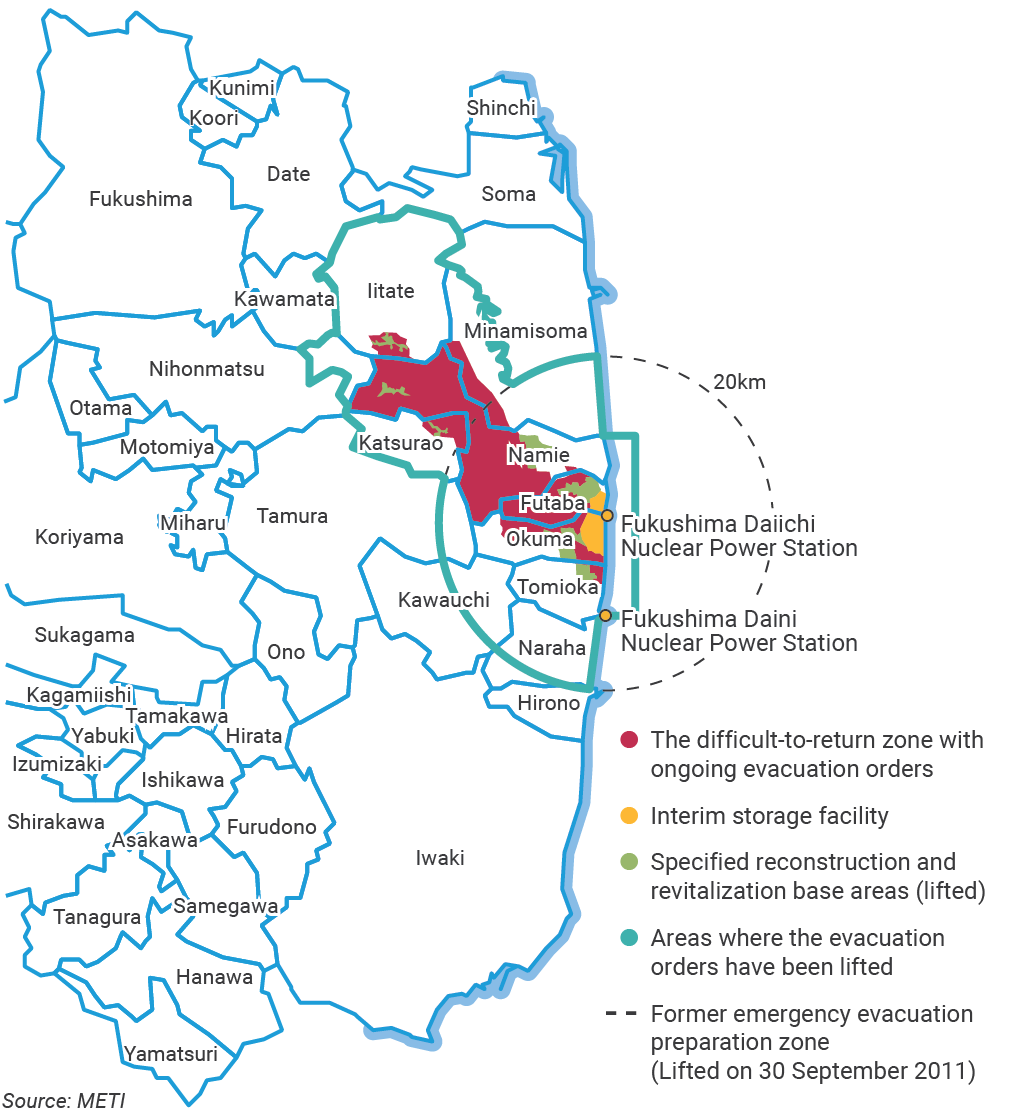
Between June 2022 and November 2023, evacuation orders were lifted for the Specified Reconstruction and Revitalization Base Areas in all six remaining municipalities: Katsurao, Okuma, Futaba, Namie, Tomioka, and Iitate. Futaba, the last town where the entire area had remained under evacuation orders, was partially reopened in August 2022. The area of Fukushima under evacuation orders has been reduced from about 12% of the prefecture in 2011 to approximately 2.2%.
Status of reconstruction of Fukushima prefecture (March 2025)
More than 2300 disaster-related deaths – not due to radiation-induced damage, the earthquake, or the tsunami – have been identified by the Japanese authorities. About 90% of deaths were for persons above 66 years of age, and about 70% occurred within the first three months of the evacuations.
The premature deaths were mainly related to: physical and mental illness brought about by having to reside in shelters and the trauma of being forced to move from homes; and delays in obtaining needed medical support because of the enormous destruction caused by the earthquake and tsunami.
However, the radiation levels in most of the evacuated areas were not greater than the natural radiation levels in some high background areas elsewhere in the world where no adverse health effect is evident, so maintaining the evacuation beyond a precautionary week or so was evidently the main disaster in relation to human fatalities.
https://www.reconstruction.go.jp/topics/20121102_sinsaikanrensi.pdf
https://www.reconstruction.go.jp/topics/240821_higashinihondaishinsainiokerushinsaikanrenshinikansuruhoukoku.pdf
Managing contaminated water, marine effects
Supplement to information in main page
Removing contaminated water from the reactor and turbine buildings had become the main challenge by week 3 of the accident, along with contaminated water in trenches carrying cabling and pipework. This was both from the tsunami inundation and leakage from reactors. Run-off from the site into the sea was also carrying radionuclides well in excess of allowable levels. By the end of March all storages around the four units – basically the main condenser units and condensate tanks – were largely full of contaminated water pumped from the buildings. Some 1000 storage tanks were set up progressively, including initially 350 steel tanks with rubber seams, each holding 1200 m3. A few of these developed leaks in 2013.
Accordingly, with government approval, Tepco over 4-10 April released to the sea about 10,400 cubic metres of slightly contaminated water (0.15 TBq total) in order to free up storage for more highly-contaminated water from unit 2 reactor and turbine buildings which needed to be removed to make safe working conditions. Unit 2 is the main source of contaminated water, though some of it comes from drainage pits. NISA confirmed that there was no significant change in radioactivity levels in the sea as a result of the 0.15 TBq discharge.
By the end of June 2011, Tepco had installed 109 concrete panels to seal the water intakes of units 1-4, preventing contaminated water passing through to the harbour. From mid-June some treatment with zeolite of seawater at 30 m3/hr was being undertaken near the water intakes for units 2&3, inside submerged barriers installed in April. From October, a steel water shield wall was built on the sea frontage of units 1-4. It extends about one kilometre, and down to an impermeable layer beneath two permeable strata which potentially leak contaminated groundwater to the sea. The inner harbour area which has some contamination is about 30 ha in area. The government in September 2013 said: “At present, statistically-significant increase of radioactive concentration in the sea outside the port of the Tepco’s Fukushima Daiichi NPS has not been detected.” And also: “The results of monitoring of seawater in Japan are constantly below the standard of 10 Bq/L” (the WHO standard for Cs-137 in drinking water). In 2012 the Japanese standard for caesium in food supply was dropped from 500 to 100 Bq/kg. In July-August 2014 only 0.6% of fish caught offshore from the plant exceeded this lower level, compared with 53% in the months immediately following the accident.
Tepco built a new wastewater treatment facility to treat contaminated water. The company used both US proprietary adsorption and French conventional technologies in the new 1200 m3/day treatment plant. A supplementary and simpler SARRY plant to remove caesium using Japanese technology and made by Toshiba and Shaw Group was installed and commissioned in August 2011. These plants reduce caesium from about 55 MBq/L to 5.5 kBq/L – about ten times better than designed. Desalination is necessary on account of seawater having earlier been used for cooling, and the 1200 m3/day desalination plant produces 480 m3 of clean water while 720 m3 goes to storage. A steady increase in volume of the stored water (about 400 m3/d net) is due to groundwater finding its way into parts of the plant and needing removal and treatment.
Early in 2013 Tepco started to test and commission this advanced liquid processing system (ALPS), developed by EnergySolutions and Toshiba. Each of six trains is capable of processing 250 m3/day to remove 62 remaining radioisotopes. By the end of 2014, an advanced ALPS of 500 m3/d had been added, making total capacity 2000 m3/d. The NRA approved the extra capacity in August 2014.
The ALPS is a chemical system to remove radionuclides to below legal limits for release. However, because tritium is contained in water molecules, ALPS cannot remove it, which gives rise to questions about the discharge of treated water to the sea. Tritium is a weak beta-emitter which does not bio-accumulate (half-life 12 years), and its concentration has levelled off at about 1 MBq/L in the stored water, with dilution from groundwater ingress balancing further release from the fuel debris.
In June 2015, 108 m3/day of clean water was being circulated through each reactor (units 1-3). Collected water from them, with high radioactivity levels, was being treated for caesium removal and re-used. Apart from this recirculating loop, the cumulative treated volume was then 1.232 million cubic metres. In storage onsite was 459,000 m3 of fully treated water (by ALPS), and 190,000 m3 of partially-treated water (strontium removed), which was being added to at 400 m3/day due to groundwater inflow. Almost 600 m3 of sludge from the water treatment was stored in shielded containers.
By early 2021, more than 1.3 million cubic metres of ALPS-treated water had accumulated in over 1000 tanks at the plant site, approaching the total storage capacity of approximately 1.37 million cubic metres.
On 13 April 2021, the Japanese Cabinet formally approved ocean discharge of the treated water over approximately 30 years, with an annual tritium release cap of 22 TBq (below the pre-accident operational limit). Following a comprehensive safety review, the IAEA concluded in July 2023 that Japan’s approach was consistent with international safety standards and that the discharge would have a negligible radiological impact on people and the environment.
The first discharge of ALPS-treated water began on 24 August 2023. Each batch of approximately 7800 cubic metres is diluted with seawater and released through a one-kilometre undersea tunnel, with tritium concentrations typically around 200-300 Bq/L – far below Japan’s operational limit of 1500 Bq/L, the WHO drinking water guideline of 10,000 Bq/L, and the regulatory limit of 60,000 Bq/L. By December 2025, 17 batches totalling approximately 125,000 cubic metres had been discharged. The IAEA maintains an onsite presence and independently analyzes each batch. Tepco began dismantling emptied storage tanks in February 2025 to free space for decommissioning work.
Related information
Fukushima Daiichi AccidentRadiation and Health Effects