What is nuclear waste, and what do we do with it?
(Image: SKB) Near the Oskarshamn nuclear power plant in Sweden, the CLAB facility stores all the used fuel from Sweden’s nuclear power plants, which for decades have provided over 30% of the country's electricity.
The electricity generated from nuclear reactors results in a small amount of waste and has been managed responsibly since the dawn of civil nuclear power. There are several management strategies in practice, such as direct disposal or reuse in reactors to generate more low-carbon electricity.
Like all industries and energy-producing technologies, the use of nuclear energy results in some waste products. Unlike any other energy generating industry, the nuclear sector takes full responsibility for all of its waste.
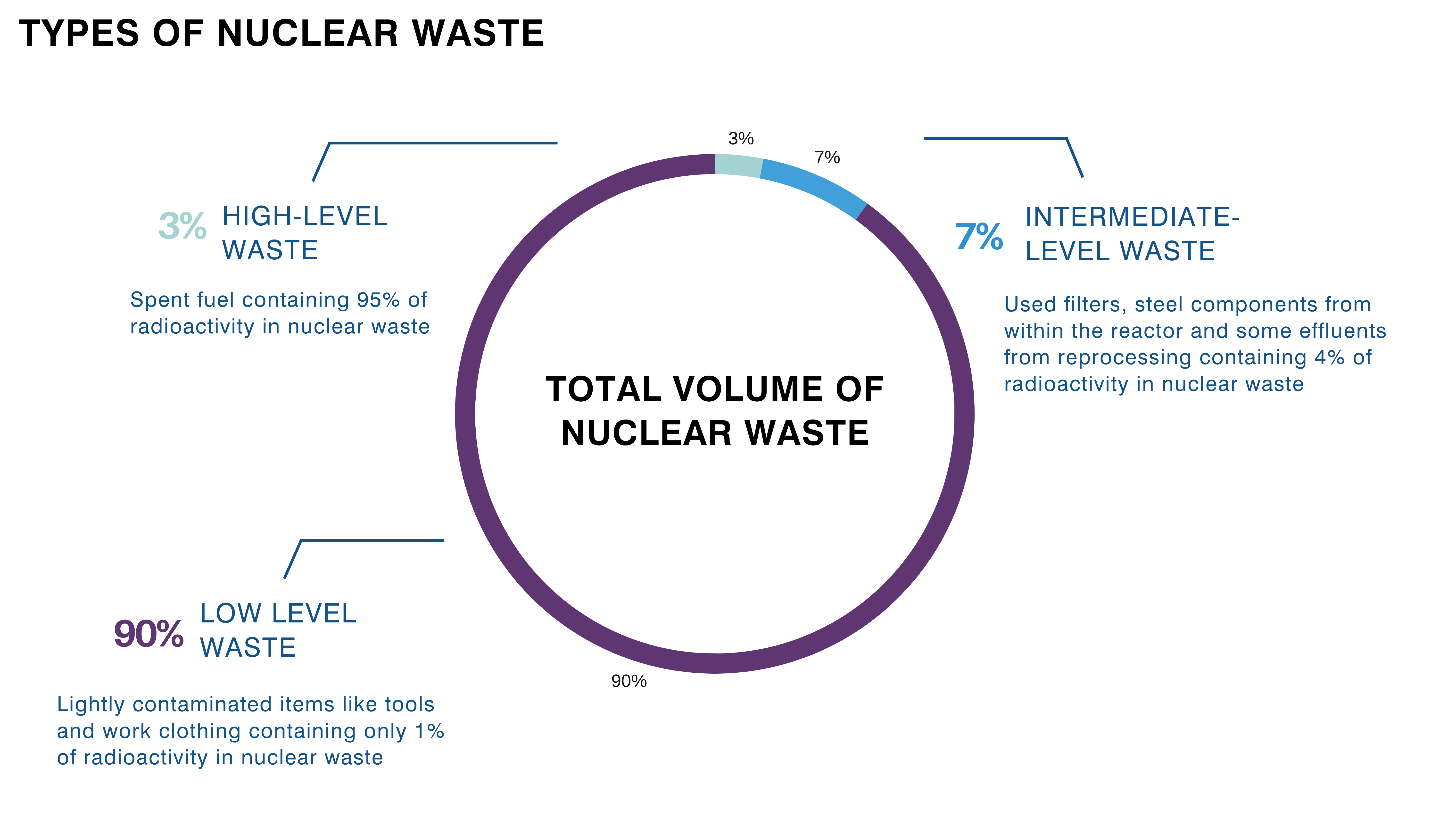
Nuclear waste is categorized by its radioactivity. The vast majority of the waste (95% of total volume) is composed of only lightly-contaminated items, such as tools and work clothing, classed as low or very-low level waste. By contrast, intermediate and high-level waste – mostly comprising used nuclear fuel – accounts for less than 5% of the total volume of waste. But contains 95% of the total radioactivity.
Five ideas to help understand nuclear waste
01 Little waste is generated High energy density, low waste volume +
Nuclear fuel is very energy dense, so relatively small amounts are needed to produce immense amounts of electricity, compared to other energy sources. As a result, a correspondingly small amount of waste is produced.
A 1 GWe nuclear power station can supply electricity to millions of homes, yet it produces only about three cubic metres of solid high‑level waste each year when the fuel is recycled. By contrast, a coal‑fired power station of the same size produces around 300,000 tonnes of ash and more than six million tonnes of carbon dioxide every year.
Fission Fact: About 400,000 tonnes of used nuclear fuel has been produced since the first nuclear power reactor commenced operation in the 1950s. By contrast, over 60 million tonnes of electronic waste is produced worldwide annually.
02 Health risks are very low Radiation levels fall quickly over time +
Since the start of the civil nuclear power industry, nuclear waste has never caused harm to people. The popular misconception is that because certain parts of nuclear waste remain radioactive for billions of years, then the threat must be sustained for that period. However, this is not the case. Whilst remaining weakly radioactive for a few hundred thousand years, the radioactivity from the main component of the waste which could cause health problems will have decayed to safe levels within a few hundred years.
We are surrounded by naturally occurring radiation, from the cosmic rays, rocks and building materials where we live, the food we eat, as well as the human body. Radiation is an unavoidable part of life on our planet, and life evolved and is thriving in this radioactive environment.
If you want to read more about radiation and its health impacts, you can read more about it on ours Radiation and Health pages.
Fission Fact: The dose rate from a nuclear waste repository would be almost 50 times smaller than the average background radiation.
03 Waste is stored safely Robust systems protect people and the environment +
Used nuclear fuel is kept in either wet or dry storage facilities, before being recycled or disposed of. When used fuel is taken out of a reactor, it is both hot and radioactive and requires storage in water to allow the fuel to cool. The fuel can be kept in wet storage, or transferred into a dry facility after a period of initial cooling. Keeping the used fuel in temporary storage to allow both the heat and radioactivity to diminish makes the recycling and disposal easier.
These are, however, not permanent storage solutions. Two main waste management strategies exist across the world: some countries have been recycling used nuclear fuel for decades; others have opted for direct disposal. This is fundamentally a strategic decision, taken at a national level and mainly driven by political and economic, as well as technological, considerations.
Fission Fact: On average, the waste from a reactor supplying a person’s electricity needs for a year would be about the size of a brick. Only 5 grams of this is high-level waste – about the same weight as a sheet of paper.
04 Used fuel can be recycled Materials are reused to make more electricity +
Most of the material in used fuel can actually be recycled. Around 97% of it can be reused, mainly uranium, which can be made into new fuel for certain types of nuclear reactors.
Recycling typically involves separating out uranium and plutonium, which can then be mixed with fresh uranium and turned into new fuel. Countries such as France, Japan, Germany, Belgium and Russia already use this approach to produce electricity, while also reducing the amount of long‑lasting radioactive waste. Only a small fraction of the material—about 4%—cannot be recycled. This remaining waste is safely managed by mixing it with glass, a process known as vitrification, before it is placed in a disposal facility.
Fission Fact: Orano Group have found that thanks to recycling, the volume of the most radioactive waste is reduced by 5 and its radiotoxicity by 10. In France, nearly 1 in 10 light bulbs run on recycled nuclear materials.
05 Remaining waste is disposed of securely Isolated deep underground +
Direct disposal is, as the name suggests, a management strategy where used nuclear fuel is designated as waste and disposed of in an underground repository, without any recycling. The used fuel is placed in canisters which, in turn, are placed in tunnels and subsequently sealed with rocks and clay. The waste from recycling – the so-called fission products – will also be placed in the repository.
Fission Fact: Repositories are nearing completion in for instance Finland, where the world's first Geological Disposal Facility (GDF) for spent nuclear fuel is expected to reach completion in 2026.
Frequently asked questions
What is nuclear waste? +
Waste includes any material that is either intrinsically radioactive, or has been contaminated by radioactivity, and that is deemed to have no further use. There are three types of nuclear waste, classified according to their radioactivity: low-, intermediate-, and high-level.
Most of the waste (90% of total volume) is composed of only lightly contaminated items, such as tools and work clothing, and contains only 1% of the total radioactivity. High-level waste, mostly comprising used nuclear fuel that has been designated as waste from the nuclear reactions, accounts for just 3% of the total volume of waste, but contains 95% of the total radioactivity.
Nuclear fuel is very energy dense, so very little of it is required to produce immense amounts of electricity. As a result, a correspondingly small amount of waste is produced.
What happens to nuclear waste and how is it managed? +
Nuclear waste (or used nuclear fuel) is kept in either wet or dry storage facilities, before being recycled or disposed of.
When used fuel is taken out of a reactor, it is both hot and radioactive and requires storage in water to allow the fuel to cool. The fuel can be kept in wet storage or transferred into a dry facility after a period of initial cooling. Keeping the used fuel in temporary storage to allow both the heat and radioactivity to diminish makes the recycling and disposal easier.
How much spent nuclear fuel exists and where is it stored? +
The IAEA estimates that 392,000 tonnes of heavy metal (tHM) in the form of used fuel have been discharged since the first nuclear power plants commenced operation.
Used nuclear fuel is stored in two main waste management strategies, with some countries recycling used nuclear fuel for decades; whereas others have opted for direct disposal.
Storage involves maintaining the waste in a manner such that it is retrievable, whilst ensuring it is isolated from the external environment. Different types include: Near-surface disposal and Deep geological disposal.
How long is nuclear waste dangerous? +
The popular misconception is that because certain parts of nuclear waste remain radioactive for billions of years, then the threat must be sustained for that period. However, this is not the case. Whilst remaining weakly radioactive for a few hundred thousand years, the radioactivity from the main component of the waste which could cause health problems will have decayed to safe levels within a few hundred years.
Is nuclear energy considered "dirty" because of waste and pollution? +
Nuclear power is a clean source of energy, it is low-carbon and contrary to public perception, only a small amount of waste is produced. Nuclear waste is not “dirty”, there are several management strategies in practice, such as direct disposal or reuse in reactors to generate more low-carbon electricity.
Can nuclear waste be recycled or reprocessed? +
Yes, nuclear waste can be recycled or reprocessed. Approximately 97% – the vast majority (~94%) being uranium – of nuclear waste could be used as fuel in certain types of reactor. Recycling has, to date, mostly been focused on the extraction of plutonium and uranium, as these elements can be reused in conventional reactors. This separated plutonium and uranium can subsequently be mixed with fresh uranium and made into new fuel rods.